10 Common Mistakes to Avoid When Preparing for the Einbürgerungstest
Introduction
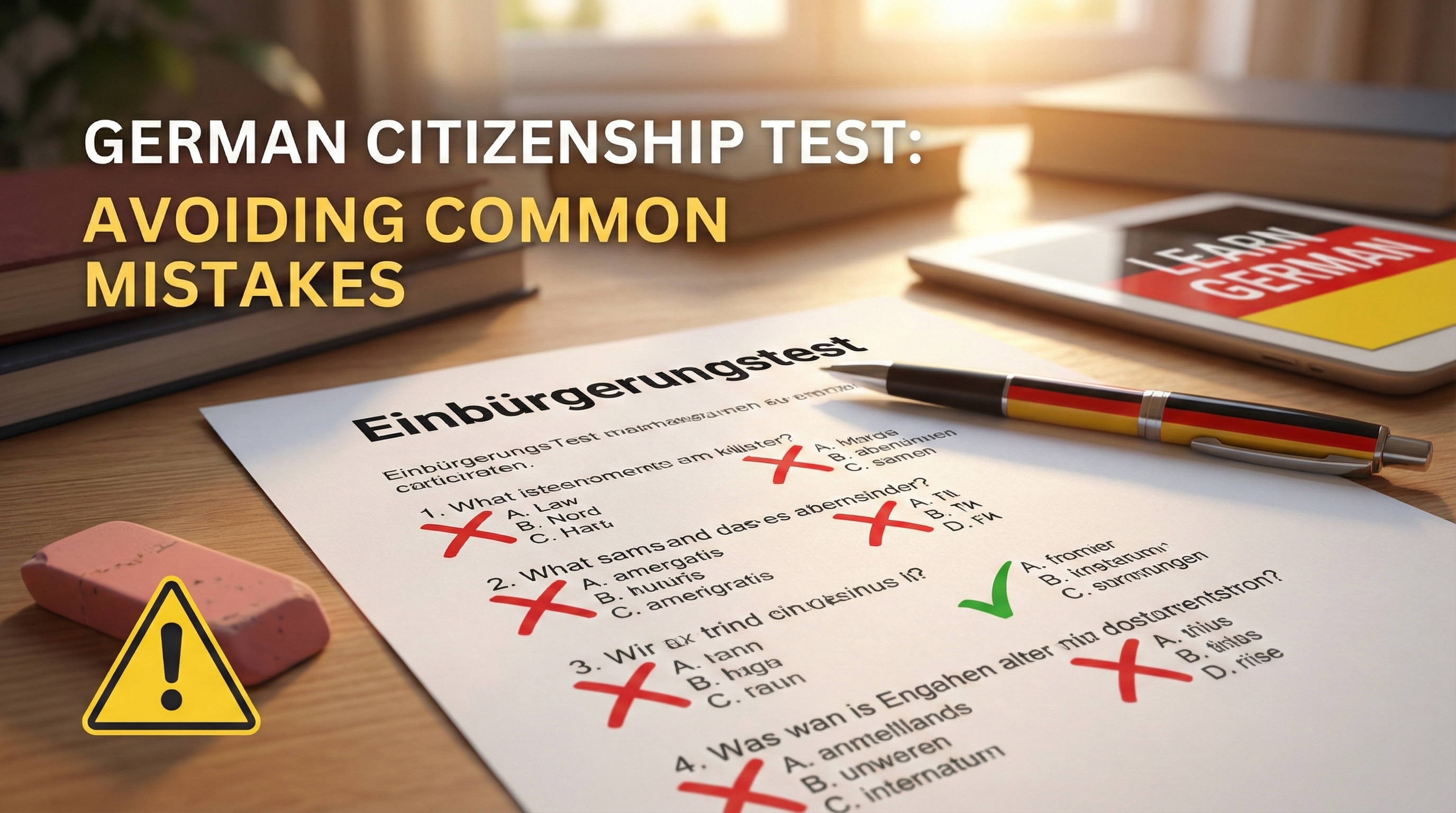
The Einbürgerungstest has a high pass rate of around 98%, but that doesn't mean you should take it lightly. Every year, thousands of applicants fail because of avoidable mistakes. Here are the top 10 mistakes and how to avoid them.
Mistake #1: Underestimating the Test
The problem: Many people assume the test is easy because of the high pass rate. They show up unprepared and fail.
The solution: Respect the test. Give yourself at least 4-6 weeks of consistent study time. The questions cover German law, history, and society - topics that require real learning, not guessing.
Mistake #2: Ignoring Your Bundesland Questions
The problem: Test-takers focus only on the 300 general questions and forget about the 10 state-specific questions. Three of your 33 questions will be about your Bundesland!
The solution: Learn all 10 questions for your state. They often cover:
- Your state's capital
- Minister-President name
- State symbols (coat of arms, flag)
- Geographic features
Mistake #3: Only Studying in English
The problem: The actual test is in German. If you only study English translations, the German wording might confuse you on test day.
The solution: Practice primarily in German. Use English translations to understand concepts, but do your mock exams in German. BürgerQuiz offers both languages for this reason.
Mistake #4: Cramming at the Last Minute
The problem: Trying to memorize 310 questions the night before doesn't work. Information doesn't stick, and you'll be exhausted.
The solution: Use spaced repetition. Study a little each day over several weeks. Your brain needs time to consolidate information into long-term memory.
Mistake #5: Memorizing Without Understanding
The problem: Pure memorization is fragile. If a question is worded differently than you practiced, you might not recognize it.
The solution: Understand the WHY behind answers. For example:
- Why is the Grundgesetz important? (Because it protects fundamental rights)
- Why did Germany reunify in 1990? (Fall of the Berlin Wall, end of Cold War)
Mistake #6: Not Taking Practice Tests
The problem: You might know the material but freeze under test conditions. Time pressure and formal settings can cause anxiety.
The solution: Take multiple timed practice tests. Simulate real conditions:
- Set a 60-minute timer
- No phone or notes
- Quiet environment
- Complete all 33 questions in one sitting
Mistake #7: Focusing Only on History
The problem: Some people spend all their time on historical dates and events, neglecting current politics and daily life questions.
The solution: Balance your study across all three categories:
- Politik in der Demokratie (about 40% of questions)
- Geschichte und Verantwortung (about 30%)
- Mensch und Gesellschaft (about 30%)
Mistake #8: Waiting Too Long to Register
The problem: Test slots fill up quickly, especially in big cities. Some people wait until the last minute and can't get a convenient date.
The solution: Register for your test 2-3 months in advance. This gives you:
- Choice of test date
- Adequate preparation time
- Buffer if you need to reschedule
Mistake #9: Arriving Late or Unprepared on Test Day
The problem: Late arrivals may be turned away. Forgotten IDs cause problems. Stress affects performance.
The solution: On test day:
- Arrive 15-30 minutes early
- Bring valid identification (passport or residence permit)
- Bring your confirmation letter
- Get a good night's sleep
- Eat a light meal beforehand
Mistake #10: Giving Up After One Wrong Answer
The problem: Some test-takers panic after getting a question wrong and lose focus for the rest of the test.
The solution: Remember: you can get 16 wrong and still pass! If you're unsure about a question:
- Eliminate obviously wrong answers
- Make your best guess
- Move on and stay focused
- Don't let one question ruin your confidence
Bonus: The Best Preparation Strategy
Here's a proven 4-week study plan:
Week 1: Overview
- Go through all 310 questions once
- Identify weak areas
- Take a diagnostic test
Week 2: Deep Learning
- Study topic by topic
- Read explanations
- Focus on understanding
Week 3: Practice
- Take daily quizzes
- Review mistakes
- Study Bundesland questions
Week 4: Mock Exams
- Take 2-3 full mock exams
- Review any remaining weak areas
- Rest well before test day
Ready to Start?
Avoid these mistakes and you'll join the 98% who pass! Start practicing with BürgerQuiz today and prepare with confidence.
Related articles
Official Resources & Useful Links for Einbürgerungstest Preparation
Comprehensive collection of official government resources, BAMF links, integration course information, and helpful tools for your German citizenship test preparation.
All 16 German States (Bundesländer): Complete Reference Guide
Complete overview of all 16 German federal states with capitals, coats of arms, and key facts. Essential preparation for the 3 state-specific questions on your test.
German History Essentials for the Einbürgerungstest
Master the key historical events tested in the Einbürgerungstest: from 1945 to reunification, including the Nazi era, Cold War division, and the fall of the Berlin Wall.