German History Essentials for the Einbürgerungstest
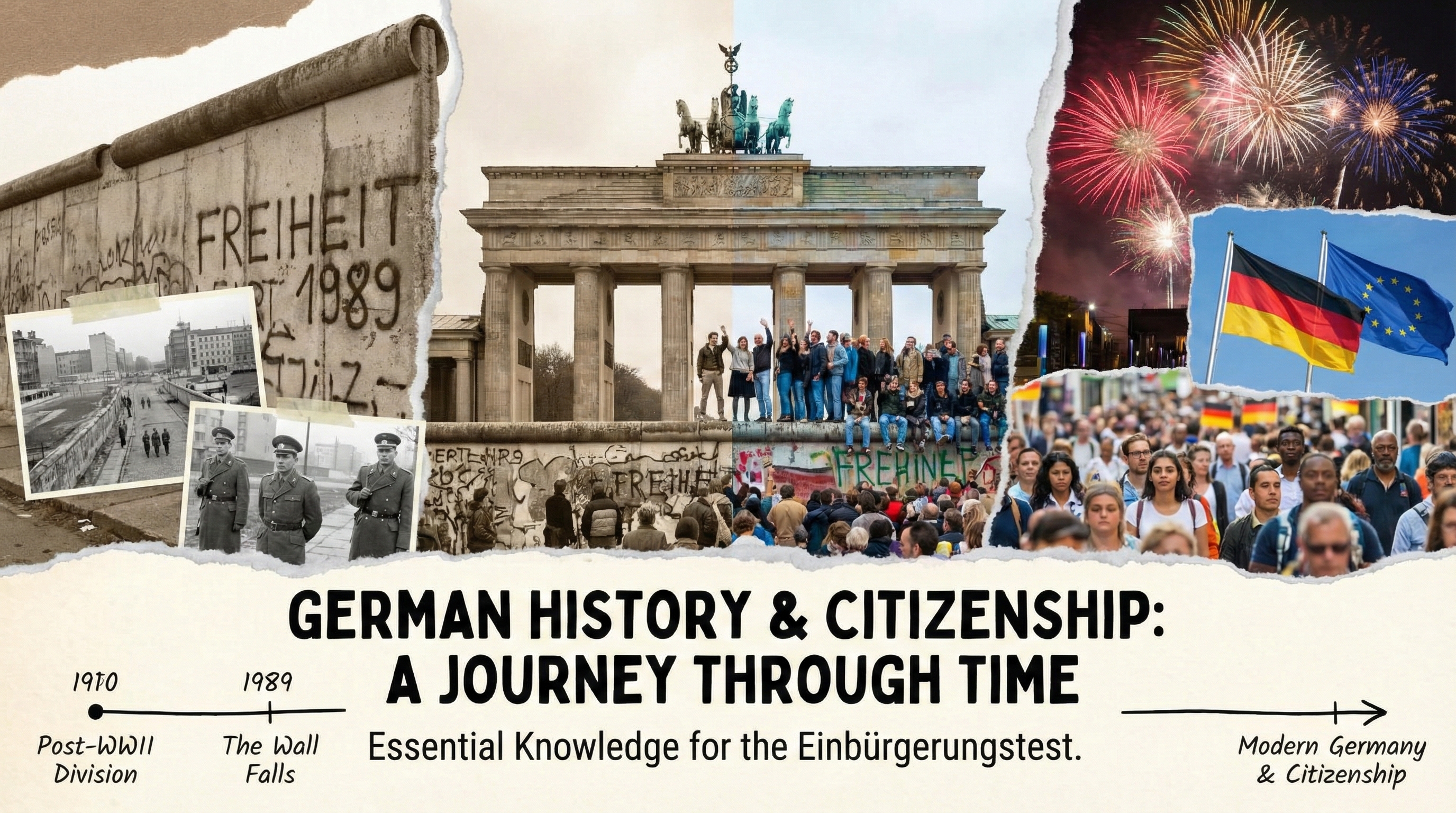
Why History Matters for the Test
About 30% of Einbürgerungstest questions cover German history, particularly from 1933 to 1990. Understanding this period is crucial not just for the test, but for understanding modern Germany.
The Nazi Era (1933-1945)
Key Dates
- January 30, 1933: Adolf Hitler becomes Chancellor
- 1935: Nuremberg Laws strip Jews of citizenship
- November 9-10, 1938: Reichspogromnacht (Kristallnacht)
- September 1, 1939: Germany invades Poland - WWII begins
- May 8, 1945: Germany surrenders - WWII ends in Europe
Important Concepts
- National Socialism (Nazism): Totalitarian ideology based on racism and nationalism
- Holocaust/Shoah: Genocide of European Jews
- Widerstand (Resistance): Germans who opposed the Nazis (e.g., Sophie Scholl, Stauffenberg)
Post-War Germany (1945-1949)
The Four Occupation Zones
After WWII, Germany was divided into four zones controlled by:
- USA - Southwest Germany
- UK - Northwest Germany
- France - Southwest (Saarland, Rhineland)
- Soviet Union - East Germany
Berlin: A Divided City
Berlin, located in the Soviet zone, was also divided into four sectors.
Two German States (1949-1990)
Federal Republic of Germany (BRD/West Germany)
- Founded: May 23, 1949
- Capital: Bonn
- System: Parliamentary democracy, market economy
- First Chancellor: Konrad Adenauer (CDU)
- Allied with: USA, NATO, Western Europe
German Democratic Republic (DDR/East Germany)
- Founded: October 7, 1949
- Capital: East Berlin
- System: Socialist one-party state (SED)
- Allied with: Soviet Union, Warsaw Pact
- Secret police: Stasi (Staatssicherheit)
The Berlin Wall (1961-1989)
Key Facts
- Built: August 13, 1961
- Purpose: Stop East Germans from fleeing to the West
- Deaths: At least 140 people died trying to cross
- Fall: November 9, 1989
Why It Fell
The Wall fell due to:
- Mass protests in East Germany (Leipzig Monday demonstrations)
- Economic collapse of the DDR
- Reforms in the Soviet Union (Glasnost/Perestroika under Gorbachev)
- Hungary opening its border to Austria
German Reunification (1990)
Key Dates
- November 9, 1989: Fall of the Berlin Wall
- March 18, 1990: First free elections in East Germany
- July 1, 1990: Economic and monetary union
- October 3, 1990: Official reunification (Tag der Deutschen Einheit)
How It Happened
The five East German states joined the Federal Republic under Article 23 of the Basic Law. This is why October 3rd is Germany's national holiday.
The Basic Law (Grundgesetz)
The German constitution was created in 1949 with lessons from the Nazi era:
- Article 1: Human dignity is inviolable
- Article 20: Germany is a democratic and social federal state
- Eternity clause: Certain principles can never be changed
European Integration
Germany has been central to European unity:
- 1951: European Coal and Steel Community (founding member)
- 1957: Treaty of Rome - European Economic Community
- 1993: Maastricht Treaty - European Union created
- 2002: Euro introduced as currency
Common Test Questions
- When did Hitler come to power? (1933)
- When did WWII end? (1945)
- When was the Berlin Wall built? (1961)
- When did the Wall fall? (November 9, 1989)
- When was German reunification? (October 3, 1990)
- What was the Holocaust? (Murder of Jews)
- What were the two German states called? (BRD and DDR)
Memory Tips
- 1933-1945: Nazi era (12 years)
- 1949: Both German states founded
- 1961: Wall built (28 years until it fell)
- 1989: Wall falls (November 9)
- 1990: Reunification (October 3 - now a holiday)
Additional Resources
Test Your Knowledge
Ready to practice? Try our history questions and ensure you're prepared for this important section of the test!
Related articles
Official Resources & Useful Links for Einbürgerungstest Preparation
Comprehensive collection of official government resources, BAMF links, integration course information, and helpful tools for your German citizenship test preparation.
All 16 German States (Bundesländer): Complete Reference Guide
Complete overview of all 16 German federal states with capitals, coats of arms, and key facts. Essential preparation for the 3 state-specific questions on your test.
Understanding the German Political System: A Complete Guide
Learn how the German government works - from the Bundestag to the Chancellor. Essential knowledge for the Einbürgerungstest covering federal structure, elections, and political parties.